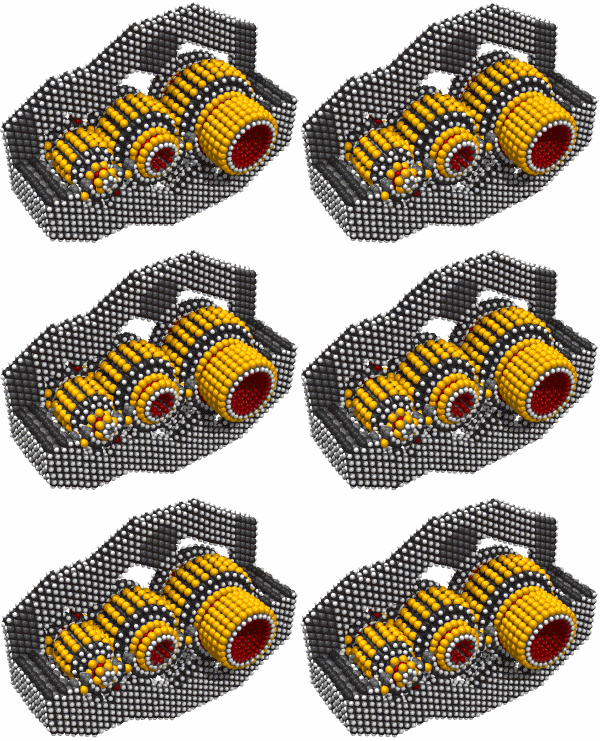
 Nanotechnology, the science of manipulating matter on the atomic level, promises to redirect the course of engineering. Breakthroughs over the last few years in the fields of microfluidics, photonics, nanoelectronics and materials science, are changing the curricula of university engineering departments and are opening up entirely new disciplines within the engineering pursuit. One of the areas that nanotechnology’s impact is becoming the most prevalent is in materials engineering. As an example of the radical change that is already underway in this field, consider that a team of engineers at the University of Illinois is developing composite construction materials that contain, embedded in their makeup, nano-designed polymer particles that act as repairing agents in the material. As the construction material cracks from either the effects of age or physical force, the polymerizing particles are released to interact with a catalyst that is also present in the material. The resulting reaction polymerizes the fissure, repairing damage to the structure as it occurs. Bridges and buildings made from nano-composites such as these could last for indefinitely longer periods than existing structures, significantly increasing public safety while decreasing the cost and inconvenience of repair. Lending the development team both credibility and capital, the U.S. Air Force has stepped in to fund the research and Boeing has shown an interest as well.
The ability to manipulate materials at such miniature scales has other uses that are currently in development. Nanocomposite polymers, resins and clays are being explored for their ability to enhance the properties of existing materials such as those used in the packaging, construction and automotive industries. Researchers believe that these nano-composites will give their users the ability to invent materials geared specificly to the function that they are intended to serve. Oxygen permeability, decreased weight and fire-resistance are just a few of the properties being currently explored in research departments around the world.
Well aware of the multitude of nanotechnology’s possible uses, experts in nano-engineering are saying that the emerging field requires a new type of engineer, a renaissance professional, equally adept in a wide variety of backgrounds. This is because the host of possible applications presented by nanotechnology spans the spectrum of industry and scientific research, encompassing the disciplines of biology, chemistry and materials development. The need to establish links between the disparate fields that these applications involve will necessitate intermediaries who understand the technical languages used exclusively in those fields. While true polymaths with an expert understanding of every field are rare, there will be a great demand for individuals versed enough in each to facilitate communication between the field’s respective experts. One can already see how the emergence of this technology is likely to create new professions within the engineering field.
Nanotechnology promises to re-invent many other fields as well, none more commonly cited than the medical industry. The image of microscopic machines entering the body to remove cancerous tissue without surgery is frequently invoked as a future likelihood, awakening both the imaginations and hopes of those who believe such a scenario is possible. Indeed, the fabrication of rudimentary nanotech devices may not be far from becoming a reality. In step with the dualistic nature of technology, however, there are also less beneficial uses inherent to the emerging field. The idea of being monitored by surveillance tools smaller than the eye can detect is bound to strike many as unnerving, as is the probable development of nanotech weaponry. Bill Joy, co-founder and chief scientist of Sun Microsystems, has himself expressed grave misgivings regarding the possible uses of nanotechnology. In his cautionary essay, “Why the Future Doesn’t Need Us”, he warns researchers against developing nano-engineered machinery with the ability to self-replicate, pointing out that an uncontainable proliferation of such devices would endanger humanity. Whether or not such dire forecasts have any validity, one prediction that can be made with relative certainty: nanotechnology will be causing radical change in the field of engineering.


Nanotechnology is the future technology